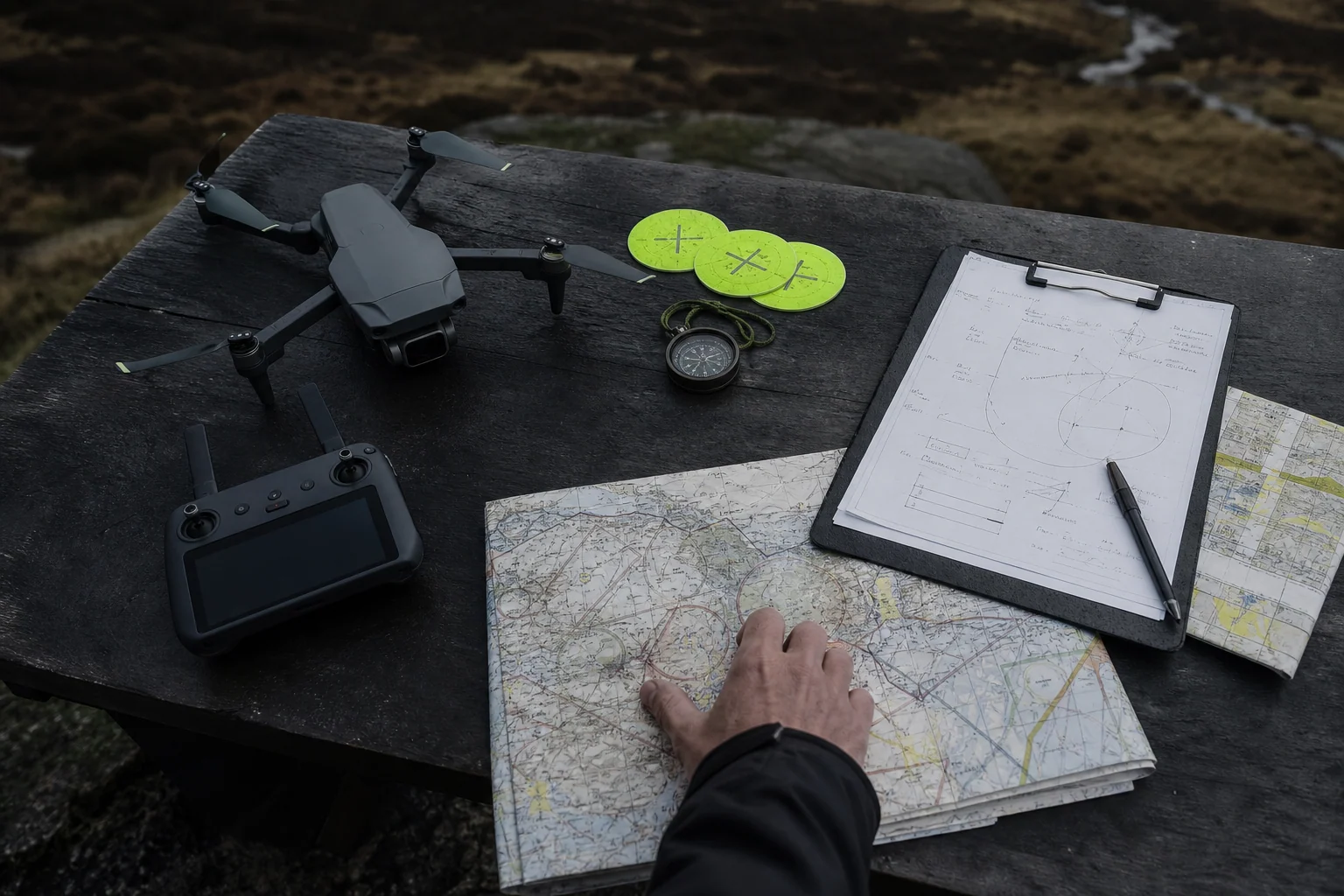
Start with the flight, not the word “commercial”.
UK aviation rules are based on the risk of the operation: aircraft class or weight, proximity to uninvolved people, location and how the flight is conducted. Being paid does not automatically move a flight into the Specific Category—but commercial flying does trigger insurance requirements.
Measured from the closest point of the earth’s surface.
Keep direct sight and a full view of surrounding airspace.
A Flyer ID is required from 100g as of 1 January 2026.
Open Category and PDRA01 do not permit flight over assemblies of people.
Every operation must remain safe, within current airspace restrictions, and within visual line of sight unless a separate authorisation permits otherwise. You must not drop articles or carry dangerous goods in the Open Category, and must give way to all other aircraft.
This is a practical summary, not legal advice or a substitute for the CAA’s Drone and Model Aircraft Code, your Operational Authorisation or Operations Manual. Rules and temporary restrictions can change; check official sources for every flight.
Which IDs do you need?
The Flyer ID belongs to the person at the controls and demonstrates that they passed the CAA theory test. The Operator ID belongs to the person or organisation responsible for the aircraft. The operator must be at least 18 and must label the aircraft with the Operator ID.
| Aircraft | Flyer ID | Operator ID |
|---|---|---|
| Below 100g | Recommended, not required | Optional |
| 100g–249g with camera | Required | Required |
| 100g–249g without camera | Required | Optional |
| 250g–less than 25kg | Required | Required |
A camera-equipped DJI Mini weighing roughly 249g now requires both IDs in the UK. Older articles saying no Flyer ID is needed below 250g are out of date from 1 January 2026.
Open Category: A1, A2 and A3
“Open” covers low-risk operations that stay within a defined set of limits. The subcategory is determined by the aircraft and the separation you maintain—not by whether the footage is for fun, YouTube or a paid production.
| Subcategory | Typical aircraft in 2026 | People and places | Competence |
|---|---|---|---|
| A1 / Over People | Below 250g; UK0/UK1; C0. C1 is also recognised through 31 Dec 2027. | May fly close to and over uninvolved people, but never over crowds. May fly in built-up areas. | Flyer ID where 100g+; follow the class and manual requirements. |
| A2 / Near People | UK2/C2; or a non-class-marked aircraft below 2kg under the applicable 50m provision. | UK2/C2: 30m, reducible to 5m in low-speed mode. Non-class-marked below 2kg: 50m. No overflight. | A2 CofC plus Flyer ID. |
| A3 / Far From People | UK2/UK3/UK4; C2/C3/C4 through transition; legacy or privately built below 25kg. | 50m from uninvolved people and 150m from residential, recreational, commercial or industrial areas. | Flyer ID and required Operator ID. |
Aircraft class, fitted accessories, battery choice and actual flying weight matter. A heavier battery or payload can change the legal route. The safest workflow is to record the exact configuration you intend to fly, then match that configuration to the current CAA table.
Where can—and can’t—you fly?
Airspace first
Most airports, airfields and spaceports have a Flight Restriction Zone. You need permission from the relevant aerodrome to enter it. Other restrictions include prohibited, restricted and danger areas, prisons, military sites and temporary restrictions around events, emergencies or VIP movements. DJI geofencing is not an authoritative airspace check.
Land access is separate from airspace
Aviation permission does not give you a right to occupy land. Obtain permission to take off and land from privately owned sites, avoid trespass, and check local byelaws. Some councils, parks, heritage bodies and estates control drone launch and landing from their property.
People, property and wildlife
- Never overfly a crowd or assembly of people.
- People inside buildings and vehicles still count when applying separation distances.
- Do not fly where you will disturb or endanger wildlife; check SSSI restrictions and seasonal nesting sensitivity.
- Do not hamper emergency services. If an incident develops nearby, land safely unless they authorise you to continue.
- For professional filming, plan privacy information, minimise collateral capture and secure personal data.
FPV and goggles
If the pilot flies by watching a live view or goggles, an observer must be next to them and able to communicate directly. At least one of them must maintain direct sight of the aircraft and a full view of surrounding airspace. FPV does not make BVLOS legal in the Open Category.
From Flyer ID to RPC-L1
| Route | What it does | Validity / status |
|---|---|---|
| Flyer ID | CAA online foundation test; starting point for A1 and A3 and prerequisite for further qualifications. | Check the expiry shown on the CAA service. |
| A2 CofC | Allows Open A2 operations. Requires self-directed practical training and a theory test of at least 30 questions via an approved provider. | Five years. |
| GVC | Recognised competence for Specific Category operations where the Operational Authorisation accepts it, including PDRA01. | Issuance ends 31 Dec 2027; existing certificates remain usable until expiry where accepted. |
| RPC-L1 Part A | VLOS competence for the Specific Category; accepted for PDRA01. Broadly similar competency level to GVC. | Five years. |
| RPC-L1 Part B | Adds BVLOS with Visual Mitigations where the authorisation permits it. | Optional extension to L1. |
| RPC-L2 / L3 | Progressive qualifications for more complex BVLOS environments under an appropriate authorisation. | Three years; entry experience and other conditions apply. |
PDRA01 Operational Authorisation
PDRA01 is currently the standard pre-defined route for many UK VLOS operations that cannot fit the Open Category. It permits aircraft below 25kg in residential, recreational, commercial and industrial areas, subject to its conditions. The CAA currently lists the authorisation at £524 for 12 months.
- Maximum 120m / 400ft from the surface and normally no more than 500m from the remote pilot.
- Normally 50m from uninvolved people, reducible to 30m during take-off and landing.
- Overflight of uninvolved people must be minimised; assemblies of people must not be overflown.
- The pilot needs a valid Flyer ID and RPC-L1 or GVC, plus competence under the Operations Manual.
- The operator needs an Operations Manual, compliant insurance, flight records and readiness for CAA audit.
If the operation is not covered by PDRA01, the operator may need a UK SORA-based Operational Authorisation. The qualification alone is not permission to fly: the operation must be conducted under an authorisation whose scope and procedures cover the flight.
Rules for paid and professional work
You can carry out commercial work in the Open Category if the operation fits all Open Category limits. A CAA Operational Authorisation is not automatically required just because money changes hands. However, the CAA states that any commercial drone operation must have third-party insurance meeting the requirements of Assimilated Regulation (EU) 785/2004.
Production work also brings contractual and data responsibilities beyond aviation law: landowner or location permission, releases where appropriate, UK GDPR and Data Protection Act compliance for identifiable people, safe storage of footage, risk assessments, and any client-required level of public liability cover.
Ask “Can this exact operation fit A1, A2 or A3?” If not, determine whether PDRA01 covers it. If neither route fits, stop and scope the authorisation needed before committing to the shot.
Remote ID and the 2026 class-mark transition
New aircraft placed on the UK market from 1 January 2026 use UK0–UK6 class marks. European C-class marks can be treated as the corresponding UK class through 31 December 2027. Confirm the marking on the actual aircraft—not only the product page.
Remote ID must be enabled now for UK1, UK2, UK3, UK5 and UK6 aircraft. For UK0 aircraft of 100g+ with a camera, UK4, legacy and privately built aircraft, the CAA’s general mandatory date is 1 January 2028. Operators receive a separate Remote ID value; its private key must not be printed on the aircraft or shared.
The 2028 treatment of an EU C-marked aircraft may differ from its temporary 2026–27 route. If you are buying a higher-value platform now, factor that regulatory uncertainty into the purchase and check the manufacturer’s UK conformity position.
How the rules meet a real filming brief.
Start with the aircraft in its actual flying configuration, then test the people, location and airspace against the available category. These examples are starting points, not automatic permissions.
| Production scenario | Likely starting route | What can stop it |
|---|---|---|
| Sub-250g establishing shot in a town | Often Open A1, with the required IDs and a safe operating area. | A crowd, FRZ or temporary restriction, unsafe proximity, no launch permission, privacy or local site rules. |
| Mavic-class shot near a controlled set | Open A2 where aircraft, qualification and separation all fit; otherwise PDRA01 may be relevant. | Uncontrolled public movement, overflight, insufficient separation or an aircraft configuration outside the chosen route. |
| Inspire-class flight in a built-up location | Usually a Specific Category operation because Open A3 requires substantial separation from people and built-up areas. | Authorisation scope, ground control, airspace permission, operating-manual limits and the practical size of the controlled area. |
| FPV chase with goggles | The aircraft still follows the applicable Open or Specific route, with an observer beside the pilot where required. | Loss of VLOS, people separation, a poor abort path, RF environment or assuming prop guards remove operational risk. |
| Night exterior | Open Category can permit night flight; Specific operations follow the authorisation and Operations Manual. | No green flashing light in Open flight, inability to maintain VLOS, unassessed lighting hazards or an unsuitable emergency landing area. |
For professional filming, identify whether people, homes or vehicle registrations may be captured. Minimise collateral footage, provide accessible privacy information where appropriate, control access to media and agree retention with production before take-off.
A legal check before every flight
- Define the operation: aircraft, actual configuration, people, place, height, distance, VLOS and time of day.
- Choose the route: A1, A2, A3, PDRA01 or a bespoke authorisation.
- Verify people separation: include people inside buildings, vehicles and the likely movement of the public.
- Check airspace live: FRZs, NATS data, NOTAMs, temporary restrictions and nearby unlicensed airfields.
- Check the ground: launch/landing permission, byelaws, site rules, wildlife and emergency activity.
- Check credentials: IDs, qualification, authorisation scope, Operations Manual currency and aircraft label.
- Check commercial cover: compliant insurance and the client’s required liability level.
- Brief the crew: observer duties, cordon, lost-link action, landing area, emergency plan and stop call.
- Document the decision: record the evidence and conditions you used, not simply “app looked clear”.
Primary sources used
Checked against official material on 2 September 2026.
Quick answers
Frequently asked questions
Do I need a licence to fly a drone in the UK?
The UK does not use one universal drone licence. Depending on the aircraft and operation, you may need a Flyer ID, Operator ID, A2 CofC, an RPC or GVC, and an operator Operational Authorisation. The flight must fit the privileges and limits of the route you use.
Can I fly a drone commercially with only a Flyer ID?
Yes, if the exact operation fits the Open Category and you meet every applicable requirement. Payment does not automatically require an Operational Authorisation, but commercial operations do require compliant third-party insurance.
Can I fly a DJI Mini in a town or city?
A sub-250g or appropriately class-marked Mini can often operate in Open A1 in a built-up area, provided the flight is safe, is not over a crowd, respects airspace restrictions and privacy, and uses a permitted take-off and landing site. A camera-equipped Mini of 100g or more requires both Flyer and Operator IDs in 2026.
Can I fly a drone at night in the UK?
Yes. In the Open Category the aircraft must display a green flashing light at all times during night flight. You must still maintain VLOS and meet every other category, airspace and safety requirement. Specific Category operators must also follow their authorisation and Operations Manual.
Does DJI FlySafe permission mean I am legally cleared to fly?
No. Manufacturer geofencing and unlocks are not aviation permission. Check authoritative airspace data, NOTAMs and temporary restrictions, and obtain any required FRZ or airspace permission separately.