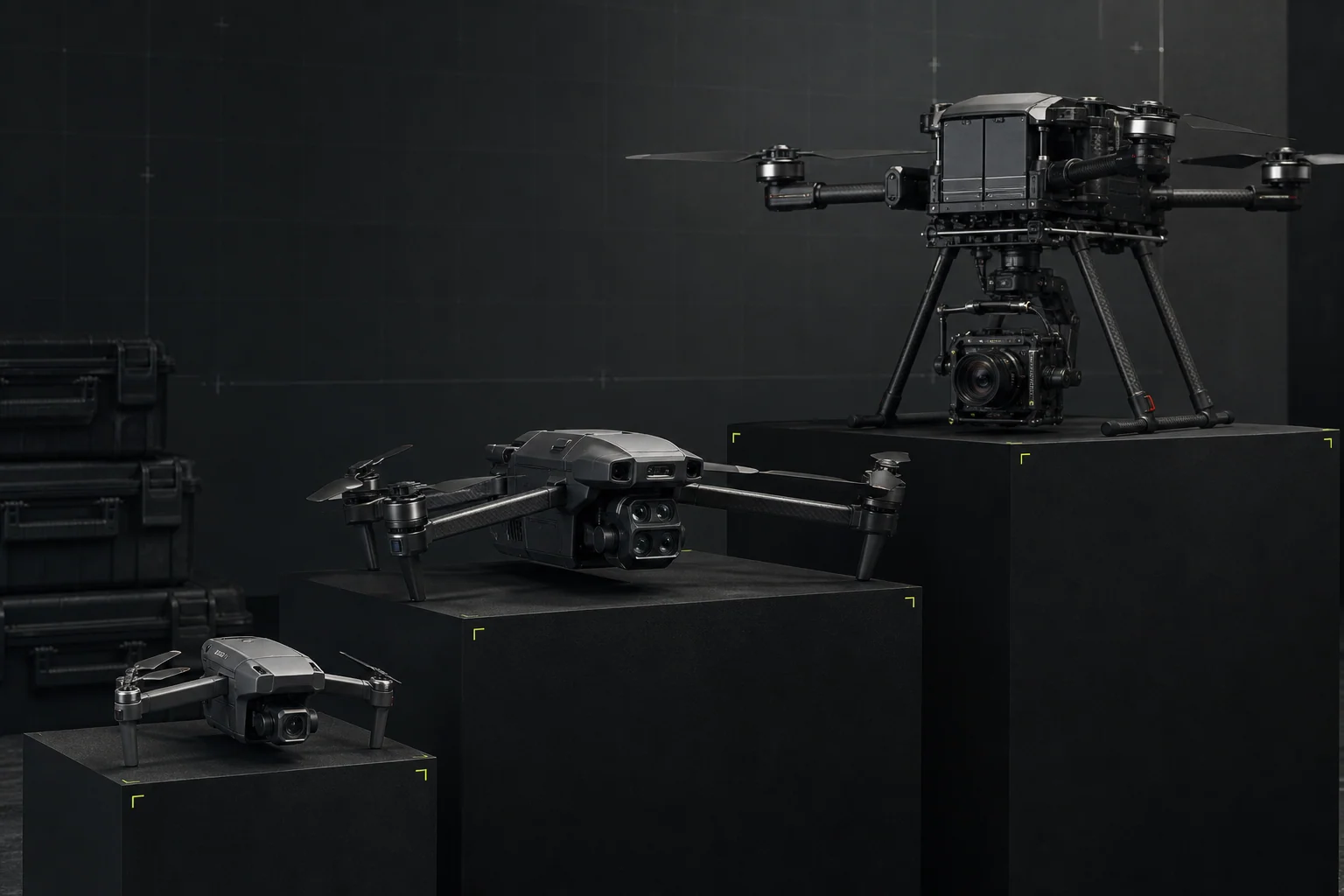
The right drone is the one the shot can use.
Camera quality is only one constraint. Aircraft mass, class mark, people separation, wind, crew size, codec, lensing, reset speed and the production’s post workflow can make a smaller aircraft the more professional choice.
Best compact image-to-weight balance and a 1-inch sensor.
Dual focal lengths, 1-inch wide camera and 724g take-off weight.
Three lenses, 6K main camera and long quoted endurance.
Full-frame 8K, interchangeable lenses, RTK and dual operation.
Manufacturer flight times are controlled maximums, not safe production endurance. Always preserve wind, return and landing reserve. UK permissions depend on the actual aircraft, configuration and operation; an EU class mark is temporarily treated as the corresponding UK class only through 31 December 2027.
Core filming specifications
| Aircraft | Weight | Main camera | Maximum video | Quoted flight | EU class |
|---|---|---|---|---|---|
| DJI Mini 4 Pro | <249g | 1/1.3in, 48MP, 24mm eq., f/1.7 | 4K up to 100fps; 10-bit D-Log M/HLG | 34 min | C0 |
| DJI Mini 5 Pro | 249.9g ±4g | 1in, 50MP, 24mm eq., f/1.8 | 4K up to 120fps; 10-bit D-Log M/HLG | 36 min | C0 standard combo |
| DJI Air 3S | 724g | 1in 50MP 24mm + 1/1.3in 48MP 70mm | 4K up to 120fps; 10-bit D-Log M/HLG | 45 min | C1 |
| DJI Mavic 3 Pro | 958g / 963g Cine | 4/3 20MP 24mm + 70mm + 166mm | 5.1K up to 50fps; 4K up to 120fps; ProRes on Cine | 43 min | C2 |
| DJI Mavic 4 Pro | Approx. 1,063g | 4/3 100MP 28mm + 70mm + 168mm | 6K up to 60fps; 4K up to 120fps; ALL-I on 512GB | 51 min | C2 |
| DJI Avata 2 | Approx. 377g | 1/1.3in 12MP, 12mm eq., 155° FOV | 4K up to 100fps; 10-bit D-Log M | 23 min | C1 |
| DJI Inspire 3 | Approx. 3,995g ready to fly | Full-frame X9-8K Air; 18/24/35/50/75mm lenses | 8K CinemaDNG; 8K ProRes RAW with licence | 28 min gear down | C3 |
“Maximum video” hides important differences. Check the exact frame rate, crop, colour mode, sampling and codec for the lens you intend to use. On multi-camera aircraft, the main camera may offer a stronger pipeline than the tele modules.
DJI Mini: access before spectacle.
Mini 4 Pro
The Mini 4 Pro remains a capable light kit: sub-249g standard configuration, 4K/100 slow motion, a 1/1.3-inch 48MP sensor, 10-bit D-Log M/HLG and omnidirectional sensing. Its vertical camera rotation is useful for social deliverables without cropping a landscape master.
Mini 5 Pro
The Mini 5 Pro moves the line forward with a 1-inch 50MP sensor, 4K/120, 42GB internal storage, improved gimbal roll range and a quoted 36-minute flight time on the standard battery. At a published 249.9g with ±4g variation, crews should confirm actual weight and fitted accessories rather than treating “Mini” as a legal category.
In the UK in 2026, either camera-equipped Mini requires both Flyer and Operator IDs because it is over 100g. Their sub-250g / C0 route is nevertheless highly useful in A1: close to uninvolved people and within built-up areas, while never over crowds and always without endangering anyone.
Location scouting, documentary access, lightweight travel, social content, tight setup time and lower-risk establishing shots.
DJI Air 3S: the rapid-response two-lens kit.
Air 3S pairs a 1-inch 50MP wide camera with a 70mm-equivalent 1/1.3-inch camera, both offering 4K up to 120fps and 10-bit options. The tele view creates stronger compression and stand-off framing than a digital crop. Forward LiDAR supplements its omnidirectional vision system, and 42GB internal storage is a useful safety net.
At 724g with an EU C1 mark, its 2026–27 UK position can be attractive: C1 is temporarily accepted in A1, including operation in built-up areas and closer to uninvolved people than the usual 50m, though intentional risk and crowd overflight remain off limits. Re-check that position before work scheduled in 2028.
Documentary, corporate, factual television, fast-moving locations and crews that need real focal-length choice without a Mavic or Inspire footprint.
DJI Mavic Pro: the production workhorse.
Mavic 3 Pro and Mavic 3 Pro Cine
The 4/3 Hasselblad main camera records 5.1K and provides adjustable f/2.8–f/11 aperture, backed by 70mm and 166mm-equivalent cameras. The Cine model adds 1TB internal storage and Apple ProRes 422 HQ/422/422 LT. That mature ProRes workflow remains a reason to keep it in a production fleet even after the Mavic 4 launch.
Mavic 4 Pro
The Mavic 4 Pro shifts the main camera to 28mm equivalent, 100MP and up to 6K/60, with 70mm and 168mm modules. It adds a gimbal capable of dramatic roll movement, forward LiDAR, O4+ transmission and a quoted 51-minute maximum. The 512GB Creator Combo offers high-bitrate H.264 ALL-I—not Apple ProRes—so confirm the post pipeline rather than assuming the newer “Creator” model replaces every Mavic 3 Cine workflow.
Both product lines carry EU C2 marks. Through 31 December 2027, the corresponding UK A2 route means an A2 CofC and the applicable 30m separation (5m in low-speed mode where all class conditions are satisfied). PDRA01 is often the more operationally relevant route for controlled professional work in built-up areas.
Commercials, television, high-end corporate, landscape, architecture and single-operator jobs needing several focal lengths and strong image quality.
DJI Avata 2: movement through space.
Avata 2 is a ducted FPV aircraft built for proximity and immersion rather than conventional floating aerials. Its 155-degree field of view, 4K/100 and 10-bit D-Log M make it useful for continuous transitions through doors, vehicles and structures where the operation is properly controlled.
Goggles create a legal crew requirement: the UK CAA requires an observer beside the pilot, with direct communication, and at least one of them maintaining VLOS and full awareness of surrounding airspace. Prop guards reduce some consequences; they do not make flight near people or property automatically safe or authorised.
Interior-to-exterior transitions, action, property walkthroughs, vehicles and shots where a wide, energetic FPV perspective is part of the visual language.
DJI Inspire 3: a flying cinema department.
Inspire 3 combines the full-frame X9-8K Air camera, CinemaDNG and licensed ProRes RAW, interchangeable 18–75mm DL lenses, RTK positioning, repeatable Waypoint Pro moves and dual control. Its raised landing gear gives the camera broad, independent movement while a pilot and camera operator split responsibilities.
The trade is operational weight: roughly 3,995g in the published filming configuration, larger batteries and charging infrastructure, more crew, shorter quoted endurance and a C3 marking. Open A3 keeps it far from people and built-up areas; professional location work typically needs an appropriate Specific Category operation such as PDRA01, with the site and people controlled to the authorisation.
Drama, commercials, features, repeatable VFX plates, independent camera operation and productions that need full-frame lens choice and cinema codecs.
The aircraft is only half the production kit.
A camera specification wins the comparison table; batteries, media, monitoring and redundancy finish the day. Build the package around the number of deliverable takes and the location workflow, not around the contents of a retail combo.
| Kit layer | Questions to answer before the job |
|---|---|
| Power | How many safe sorties does the shot list require? Can batteries cool and recharge on location? Is mains or vehicle power dependable? |
| Media | Does every card sustain the selected codec? Is there enough capacity for high-frame-rate rehearsals and duplicate handoff? |
| Optics | Are the correct ND strengths, lens hoods, cleaning tools and spare protective filters available for the day’s light and environment? |
| Monitoring | Can the director or camera department see a stable, colour-useful image without distracting the pilot or sharing a safety-critical screen? |
| Control | Are controller, cables, firmware and app versions known and tested? Is there a compatible spare for the critical aircraft? |
| Recovery | Can another aircraft complete the priority shot with an acceptable image and legal route if the first system is grounded? |
Salt, sand, rain, cold and dust affect turnaround as much as flight performance. Include landing mats, weather protection, safe battery storage, tools and a clean media station in the recce plan rather than improvising them beside the aircraft.
Choose by constraint, in this order.
- Legal access: can the aircraft conduct this operation in the available category and controlled area?
- Shot language: conventional aerial, tele compression, FPV immersion, repeatable move or independent camera operation?
- Post pipeline: required resolution, colour profile, codec, media and lens matching?
- Environment: wind, temperature, RF, salt, dust, altitude, confined space and wildlife?
- Crew: solo, observer, camera operator, ground control and production liaison?
- Turnaround: battery cycle, charging, card offload, reset time, transport and redundancy?
A useful two-aircraft production kit often pairs a Mini or Air for access and rapid recce with a Mavic or Inspire for hero shots. The backup should be capable of completing the brief, not merely sharing the same controller bag.
Buy the utilisation. Hire the capability.
Ownership makes sense when the same platform earns regularly, the crew can maintain currency and the post pipeline repeatedly uses its strengths. Otherwise, hire the package that fits the brief—or bring in an operator whose authorisation, experience and crew are already matched to the location.
Best when the platform is used often enough to keep batteries, firmware, skills and insurance current.
Useful when lenses, codecs, payload or camera class vary more quickly than the jobs repeat.
Bring the operational system—pilot, authorisation, camera operator, paperwork and aircraft—not only a box of hardware.
Pair light access with a hero platform when no single aircraft can solve every shot safely.
Cost the complete year: aircraft, batteries, media, cases, accessories, qualification, authorisation, insurance, maintenance, replacement cycle and non-billable practice. A more expensive platform that rarely leaves the shelf is not a production advantage.
Official specification sources
Specifications checked on 2 September 2026. Manufacturer test conditions apply.
Quick answers
Frequently asked questions
What is the best DJI drone for professional filmmaking?
For many single-operator productions, the Mavic 4 Pro offers the broadest mix of image quality, focal lengths and portability. A Mini or Air can be the better professional tool where access and speed matter, while Inspire 3 serves productions needing full-frame interchangeable lenses, cinema codecs and separate pilot and camera roles.
Is the DJI Mini 4 Pro good enough for professional video?
Yes, when its camera, codec and wind capability fit the brief. It is particularly useful for documentary, travel, location scouting, social deliverables and lower-footprint establishing shots. Test it against the production colour pipeline and do not choose it solely because of its weight.
Is the Mavic 4 Pro better than the Mavic 3 Pro Cine?
It depends on the pipeline. Mavic 4 Pro adds a newer triple-camera system, 6K main camera and longer quoted endurance. Mavic 3 Pro Cine retains an established internal Apple ProRes workflow. Confirm the required codec, lenses, media and delivery before treating either as a universal replacement for the other.
When should a production use an Inspire 3?
Use Inspire 3 when the brief benefits from full-frame interchangeable lenses, 8K cinema recording, repeatable positioning or independent camera operation—and when the budget, crew, permissions, site control and battery infrastructure support the larger system.
Should I buy or hire a cinema drone?
Buy when utilisation, maintenance capability and post workflow are consistent. Hire when the camera requirement changes between jobs or when ownership would leave expensive batteries and aircraft underused. Subcontract a specialist crew when the operational authorisation, aircraft, crew roles and location complexity are more valuable than the hardware alone.